How to buy 131,000 energy for a first-time recipient
A transfer to someone who has never held USDT writes a new record inside the token contract, and writing that record is what doubles the energy bill — from about 65,000 to about 131,000.
3 min · 4 steps · updated September 24, 2026
- 01
Know when the bigger number applies
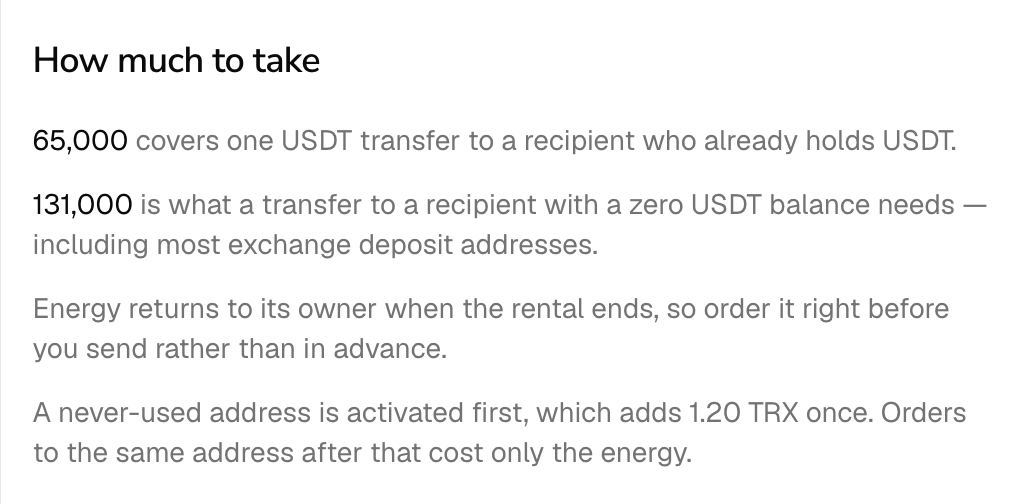
The token contract keeps a balance for every holder. Paying someone who already has USDT changes a number that is there; paying someone with none has to create it, and creating storage is the expensive part of the operation. That single difference is the whole gap between the two amounts.
In practice you need the larger one for exchange deposit addresses, which are often generated fresh for you, for a first payout to a new wallet, and for anyone you are paying in USDT for the first time. Repeat payments to the same person are back to the smaller amount.
- 02
Move the counter to two transfers
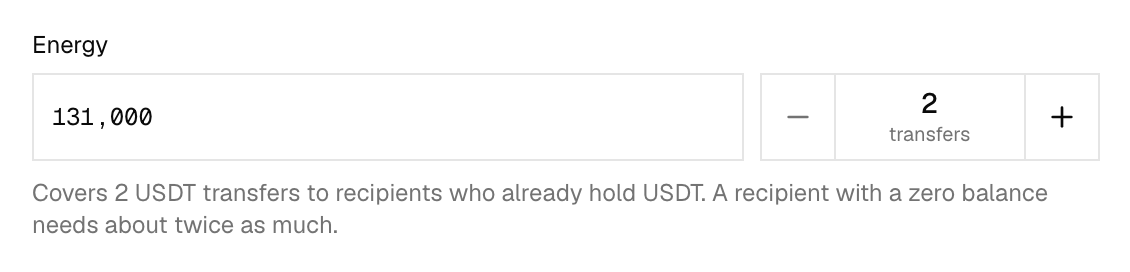
The form counts in transfers rather than raw units, and two of them is exactly the 131,000 this case needs. Type the number straight into the field if you prefer — the counter follows either way.
- 03
Compare the total against burning
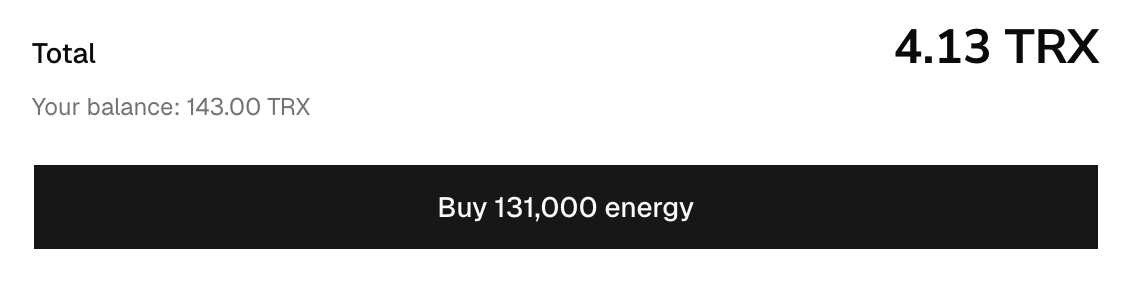
Around 4 TRX buys what the network would charge roughly 13 TRX to burn for the same transfer. The gap is the reason to rent at all, and it is widest exactly here, on the transfers that cost the most.
Ordering more than you need is the cheaper mistake: unused energy is simply returned when the rental ends. Ordering too little is the expensive one — the network burns TRX for whatever is missing, at full price.
- 04
Send while the rental lasts
Delivery takes seconds and shows up below with its transaction. The energy sits on your address for 15 minutes, which is time enough to paste an amount and confirm, but not time enough to leave it for later.
If you are unsure whether the recipient holds USDT, take the larger amount. Guessing low costs more than guessing high.

Questions
- How do I check whether the recipient already holds USDT?
- Open their address on Tronscan and look at the USDT balance. Zero, or no USDT line at all, means the larger amount applies.
- Is 131,000 exact?
- It is the safe round figure. The real cost drifts a little with the contract and the network, which is why the form offers a margin rather than the bare minimum.
- Why do exchange deposits so often need it?
- Exchanges hand out addresses that have never received that token before, so your payment is the one that creates the balance record.
- What happens to energy I do not use?
- It goes back to the owner it was rented from when the 15 minutes are up. You are not charged for the leftovers and there is nothing to return by hand.